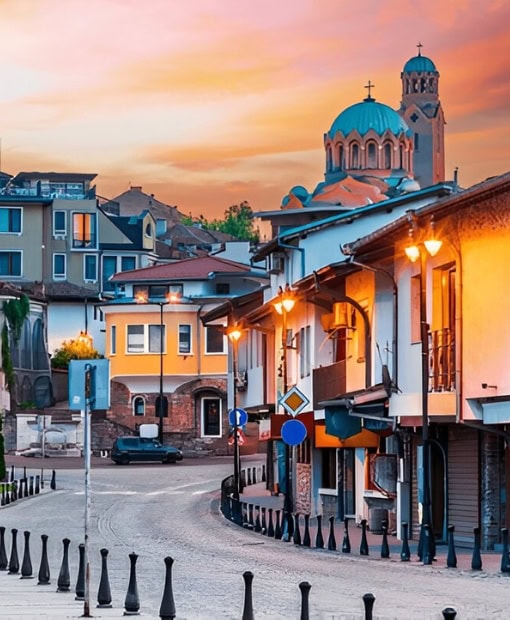
The eSIM worked well in major cities like Varna, but I struggled with slow speeds in rural areas. The installation process was a bit confusing for me at first, but I figured it out after a few tries. It served its purpose but could use improvement.
CF
Charlotte F.
Montreal, CA · May 2026
Perfect for Traveling
Using esima's eSIM in Bulgaria was a game changer for my trip! Installation was quick with the QR scan, and I enjoyed seamless internet access everywhere, even at the Black Sea. Customer service was responsive when I had questions, which was a nice bonus!
MR
Michael R.
Los Angeles, US · May 2026
Seamless connection in Sofia
I activated my esima eSIM as soon as I landed in Sofia and it worked perfectly! The QR code made installation a breeze. I enjoyed 5G speeds while exploring the city and streaming my favorite shows. Highly recommend!
JK
James K.
Manchester, GB · May 2026
Reliable and fast
Using esima while traveling through Bulgaria was a great experience. I had quick access to 4G all across Sofia and several smaller towns. The setup was straightforward, and I appreciated the ability to easily manage my data usage through the app.
IB
Isla B.
Auckland, NZ · May 2026
Seamless and fast!
I loved using the esima eSIM during my week in Bulgaria! The setup was a breeze with the QR code, and I enjoyed fast 5G speeds throughout Sofia. It made navigating public transport and using maps so easy. Will definitely use it again!
WL
Wei L.
Singapore, SG · May 2026
Easy setup and reliable
I loved how easy it was to get connected in Plovdiv! The QR code scanned instantly, and I had no issues at all during my week there. I even managed to stream shows without buffering. Definitely a lifesaver!
DH
David H.
Chicago, US · May 2026
Smooth Connection in Sofia
The eSIM worked perfectly right after scanning the QR code at Sofia Airport. I had 5G speeds throughout the city, which made navigating and streaming my favorite shows a breeze. Highly recommend for anyone visiting Bulgaria!
MD
Marco D.
Rome, IT · May 2026
Great service overall
I loved how quick it was to get connected after arriving in Sofia. The customer service was helpful when I had questions about installation. There were a few moments of slow speed in the countryside, but it worked well most of the time.
eSIM vs roaming in Bulgaria
Typical home-carrier roaming
$10–$18
per day
Esima eSIM
$2.57
Flat rate
Most international carriers charge a flat daily fee for Bulgaria — common structures give you one or two gigabytes at full speed, then throttle to unusable speeds for the rest of the day, and hotspot is often blocked or costs extra.
That daily fee repeats every 24 hours whether you use 100MB or 2GB, so a week in Sofia and the coast runs the same price as a week in your home country.
The esima eSIM is a fixed upfront cost for a set data bucket — 3GB, 5GB, 10GB, whatever you pick — with no throttling and no surprise charges when you tether your laptop on a train with no Wi-Fi.
You know the total before you land, and the price does not multiply by the number of days you stay.
Roaming bundles from major networks also lock you to a single carrier, so if that carrier is weak in Bansko or the Rhodopes, you are stuck; the eSIM hands off between Vivacom, A1, and Yettel automatically.
Real trips, real travelers
Built for travelers like you
Different trip, same eSIM — here is how it lands for the most common visitors to Bulgaria.
You are in Bansko for a week of skiing. The eSIM gives you LTE at the gondola base to coordinate with your group, check avalanche reports, and book dinner reservations. Coverage dies halfway up the slopes, so you set a fixed meeting time at the lodge rather than relying on live messages. After skiing, you hotspot your laptop at the hotel to catch up on work — the lodge Wi-Fi is slow and unreliable.
Ski-season traveler
You are moving between Varna, Nessebar, and Sozopol over ten days. The eSIM keeps you online for Bolt rides, restaurant reservations, and beach-bar lookups. Summer crowds slow speeds during lunch and evening hours, but you stay connected. The coastal road between towns has patchy LTE — you download playlists offline before each drive.
Black Sea coast hopper
You are splitting a week between Sofia meetings and a Plovdiv conference. The eSIM validates your metro tickets in Sofia's Urban Mobility Center app, keeps email synced on the BDZ train (which has no Wi-Fi), and tethers your laptop at the Plovdiv hotel when the conference center network is overloaded. You never touch a physical SIM or hunt for a kiosk.
Sofia-Plovdiv business traveler
Apps you'll need data for in Bulgaria
The apps locals and travelers actually use — the ones that need real cell data, not just hotel Wi-Fi.
Urban Mobility Center
Sofia metro and tram tickets with live QR validation
Bolt
Rideshare in Sofia, Plovdiv, Varna, and Burgas
EasyPay
Mobile wallet for bills, parking, and transit top-ups
Google Maps
Navigation and public-transit routing
Vivacom My Account
Check data balance and top up if needed
B
BDZ Mobile
Bulgarian rail tickets and schedules
How much data you'll burn per day
WhatsApp
~40MB per day for text and voice messages, ~120MB per day if you are making regular voice calls, ~300MB per day with video calls.
Maps
~5MB per hour of active turn-by-turn navigation; a full day of city walking or driving uses 30-50MB. Download offline maps for mountain regions.
Rideshare
~2MB per ride for Bolt — requesting, tracking, and payment. A week of daily rides in Sofia or Varna uses under 50MB total.
When you're travelling matters
Summer on the Black Sea coast brings tourist crowds that saturate cell towers in Sunny Beach, Golden Sands, and Nessebar — expect slower speeds between noon and evening, though you will stay online.
Ski season in Bansko (December through March) means reliable LTE at the base but dead zones on higher slopes; download trail maps and avalanche reports before heading up.
Spring and autumn in the Rhodope and Pirin ranges offer the best hiking conditions, but coverage remains LTE-only in towns and nonexistent on high trails — carry offline maps and a backup battery if you are doing multi-day treks.
FAQ
Frequently asked questions
Does the eSIM work in Bansko ski resort?
Yes — Vivacom and A1 both have full LTE at the base, the gondola station, and the main lodge areas. Coverage drops on higher slopes and disappears entirely on the Pirin hiking trails above tree line. Download offline maps and set a fixed meeting point at the base rather than relying on live location sharing.
Will I have signal at Rila Monastery and the Seven Rila Lakes?
Rila Monastery itself has 4G on Vivacom. The hiking trails to the Seven Rila Lakes lose signal above 2,000 meters on all carriers — plan your route offline and carry a physical map if you are doing the full circuit.
Does the eSIM work on the train from Sofia to Burgas?
Yes, and you will need it — BDZ trains on that route have no onboard Wi-Fi. The eSIM stays connected through most of the journey, though you will hit short dead zones in valleys between Plovdiv and the coast. Vivacom and A1 handle the route better than Yettel.
How much data do I need for a week in Sofia and the Black Sea coast?
Three to five gigabytes covers maps, rideshare, the Urban Mobility Center app for metro tickets, and light social media. If you are streaming on the train or uploading photos daily, go for seven to ten gigabytes. Video calls and hotspot tethering will push that higher.
Can I use the Urban Mobility Center app for Sofia metro tickets with this eSIM?
Yes — the app generates a live QR code that validators scan at metro and tram gates. You need working data every time you enter; paper tickets are being phased out at automated turnstiles, so the eSIM is not optional if you are relying on the app.
Does the eSIM work in Sunny Beach and the Black Sea resorts?
Yes — all three carriers have reliable 4G along the coast in summer. Sunny Beach, Nessebar, Sozopol, and Varna are well covered. Speeds slow during peak hours when crowds saturate the towers, but you will stay online. Rural areas between resorts thin to 3G on Yettel.
Vivacom or A1 Bulgaria — which has better coverage in Plovdiv?
Both have 5G in Plovdiv's old town and the Kapana district. Vivacom has a slight edge in the Rhodope Mountains south of the city, where A1 drops to LTE faster. For in-city use, the difference is negligible — the eSIM will hand off to whichever is stronger at your location.
Can I make WhatsApp calls in Bulgaria with this eSIM?
Yes — WhatsApp voice and video calls work over the data connection. Quality is solid in Sofia, Plovdiv, and Varna on 5G or LTE. Expect dropouts in the mountains and on higher ski slopes where coverage thins.
Is there signal in the Rhodope Mountains?
LTE coverage exists in the main towns — Smolyan, Pamporovo, Chepelare — but thins fast on mountain roads and hiking trails. Vivacom has the widest footprint; A1 and Yettel drop to 3G or lose signal entirely in remote valleys. Download offline maps before heading into the range.
Does Bolt rideshare work on this eSIM in Sofia?
Yes — Bolt needs live data to request rides, track drivers, and process payments. The eSIM keeps you online across Sofia's city center and metro area. Coverage is strong enough that you will not lose the driver's location pin even in underground parking or metro stations.
eSIM vs buying a SIM card at Sofia Airport — which is better?
A physical SIM from an airport kiosk costs about the same per gigabyte and requires a passport photocopy, a queue, and sometimes a deposit. The eSIM activates before you leave the arrivals hall, so you can call a Bolt or validate a metro ticket immediately. Both give you access to the same networks; the eSIM just saves the setup time.
Will the eSIM work in Burgas and the southern coast?
Yes — Burgas city center has 5G on Vivacom, and the coast down to Sozopol has reliable 4G on all three carriers in summer. Yettel is the weakest; Vivacom and A1 handle beach towns better. Expect slower speeds during peak tourist season when towers are saturated.
How much data does Google Maps use for a day of driving in Bulgaria?
Active turn-by-turn navigation uses about 5MB per hour of driving. A full day of road-tripping — Sofia to Plovdiv to Varna, for example — will consume 30 to 50MB if you keep the map live. Download offline maps for the Rhodopes and Pirin ranges where coverage is patchy.
Does the eSIM support hotspot for my laptop on Bulgarian trains?
Yes — hotspot and tethering are enabled by default. BDZ trains have no onboard Wi-Fi, so this is the only way to work or stream between Sofia and Plovdiv or Burgas. Expect short dead zones in valleys; Vivacom and A1 hold signal better than Yettel on those routes.
Is there 5G in Varna?
Vivacom has 5G in Varna's city center and along the Sea Garden promenade. A1 also offers 5G in the downtown area. The beach resorts north and south of Varna — Sunny Beach, Golden Sands — are 4G only. All three carriers handle the coast well in summer, though speeds drop during peak hours.
Need broader coverage?
Going further than Bulgaria? These plans include Bulgaria plus everywhere in between.
Sofia's Urban Mobility Center app validates metro and tram tickets with a live QR code — paper tickets are being phased out at automated gates, so you need working data the moment you step off the plane. A Bulgaria eSIM connects you to Vivacom, A1 Bulgaria, or Yettel the second you land, skipping the airport kiosk queue and the roaming bill your home carrier would slap on every tower ping from the Pirin Mountains to the Black Sea coast.
Choose your plan
8 options
Balanced use — social, navigation & light streaming
Choose number of eSIMs
How many travelers?
1 eSIM
Total$7.93
Secure payment
30-day guarantee
A1 Bulgeria5G
Features
Data-only plan, no contract
Works on 5G / 4G LTE networks
Choose when your plan activates
Connects to top local carriers
No physical SIM swap needed
24/7 customer support
Description
You scan the QR code esima sends, confirm the install in your phone's settings, and the eSIM registers on a Bulgarian network before you leave the arrivals hall. No counter, no passport photocopy, no deposit.
Sofia's metro validators expect a live QR code from the Urban Mobility Center app — the city is phasing out paper tickets at automated gates, so working data is not optional.
The same eSIM that gets you through the turnstile in Sofia keeps you online on the BDZ train to Plovdiv, where onboard Wi-Fi does not exist and the route cuts through valleys where only one carrier holds signal.
In Varna and the Black Sea resorts, summer crowds saturate the towers but all three carriers keep 4G stable. Bansko's base station covers the gondola queue and the lodge, but the signal dies halfway up the slopes — tell your group to meet at a fixed spot rather than relying on a live pin.
The Rila and Pirin ranges are beautiful and mostly offline; Vivacom reaches Rila Monastery itself, but the hiking trails above tree line are dead zones.
A physical SIM from a Bulgarian kiosk costs the same per gigabyte and requires a trip to a shop; the eSIM saves that hour and starts working the moment your plane touches down.
Technical specs
Network
A1 Bulgeria5G
Coverage
Bulgaria
Delivery
Immediate, by email
Plan type
Data only
Phone number
No
SMS / calls
VoIP apps only
Activation
QR code or manual SM-DP+
Why travelers choose Esima
Three reasons travelers pick esima for Bulgaria. First: you pay local-market rates, not the inflated roaming markup your home network charges for Bulgarian towers.
Second: the eSIM hands off between Vivacom, A1 Bulgaria, and Yettel automatically, so you get the strongest signal in Plovdiv's old town or on the Sofia-Burgas train rather than being locked to one carrier's dead zone.
Third: hotspot and tethering are enabled by default — critical when BDZ trains have no onboard Wi-Fi and you need to work between Sofia and Plovdiv, or when you are sharing a rental car with a partner whose phone does not support eSIM.
Instant delivery
Your QR code lands in your inbox minutes after purchase.
No roaming bills
Pay one upfront price — no surprise charges abroad.
Keep your number
Your physical SIM stays active for calls and texts.
Fast 4G/5G
Connect to top-rated local networks at full speed.
24/7 support
Real humans ready to help, any time zone, any day.
Easy install
Scan once and you're online — no app, no SIM swap.
Coverage in Bulgaria
Our Bulgaria eSIMs run on Vivacom, A1 Bulgaria, and Yettel. Vivacom has the widest 5G rollout — you will see it in Sofia, Plovdiv, Varna, and Burgas city centers, plus Plovdiv's old town.
A1 Bulgaria matches that 5G footprint in Sofia and Plovdiv. Yettel offers reliable 4G along the Black Sea coast in summer — Sunny Beach, Nessebar, Sozopol — but thins to 3G in rural areas.
Bansko ski resort has full LTE at the base on Vivacom and A1, but coverage drops on higher slopes and the Pirin hiking trails. The Rhodope Mountains south of Plovdiv are LTE-only.
Rila Monastery area has 4G on Vivacom, but the Seven Rila Lakes trails above 2,000 meters have no signal on any carrier. Download offline maps before heading into the mountains.
Network
A1 Bulgeria5G
Good to know
Download offline maps before driving into the Rhodope or Pirin ranges — LTE ends fast outside Plovdiv and Bansko.
BDZ trains on the Sofia-Plovdiv-Burgas route have no Wi-Fi; the eSIM is your only connection for work or streaming.
Bansko's ski slopes lose signal above the mid-station on every carrier — set a fixed meeting point at the base lodge.
The Urban Mobility Center app in Sofia requires live data for ticket validation; paper tickets are being phased out at metro gates.
Rila Monastery has 4G on Vivacom, but the Seven Rila Lakes trails above 2,000 meters are dead zones — plan accordingly.
Sunny Beach and the Black Sea coast have reliable 4G in summer, but rural areas between resorts thin to 3G on Yettel.
Coverage in Bulgaria — top cities
Sofia
Vivacom and A1 both blanket the city center with 5G — you will pull 150+ Mbps near the National Palace of Culture and along Vitosha Boulevard. The metro has full LTE on all three lines, and the Urban Mobility Center app needs live data to generate ticket QR codes at every validator. Coverage stays strong out to Vitosha Mountain's lower trails, then drops to LTE and eventually nothing above the ski lifts.
Plovdiv
The old town has 5G on Vivacom and A1 — signal reaches inside the Roman amphitheater and the Ethnographic Museum courtyards. The pedestrian Kapana district is fully covered. Head south into the Rhodope Mountains and you fall back to LTE within 20 minutes; the villages past Bachkovo Monastery are 3G or offline depending on which carrier your eSIM picks.
Varna
Varna's city center and the Sea Garden promenade have reliable 4G on all three carriers. Summer crowds in Sunny Beach and the resort strip slow speeds during peak hours, but you will stay online. Yettel is the weakest of the three along the coast — Vivacom and A1 handle the beach towns better. The coastal road north to Balchik has patchy LTE; expect gaps between towns.
How to set up your eSIM
1
Check compatibility
Make sure your phone supports eSIM — most recent models do.
2
Buy your eSIM
Pick a plan and pay securely. Your QR code arrives by email in minutes.
3
Scan & connect
Scan the QR code, enable data roaming on arrival, and you're online.
 WhatsApp +44 7367 063273