The eSIM was seamless! I scanned the QR code right after landing in Vaduz and was connected in seconds. 5G speed made streaming maps and Netflix a breeze. Highly recommend for anyone traveling to Liechtenstein!
SM
Sarah M.
London, GB · May 2026
Fantastic Data Service
I highly recommend esima for anyone traveling to Liechtenstein! The installation was instantaneous, and I had no problems streaming Netflix while relaxing by the Rhine. It’s the perfect solution for travelers.
SW
Sophie W.
Toronto, CA · May 2026
Good value for Liechtenstein
I opted for the eSIM for my trip and was pleasantly surprised. The speed was mostly great, especially in urban areas like Balzers. Installation was quick with the QR code, but I did notice some drops in signal in the valleys. Overall, worth it!
JA
Jordan A.
Johannesburg, ZA · Mar 2026
Decent but could improve
While the eSIM provided decent service in Vaduz, I experienced slow speeds in more remote areas. The installation was straightforward, but I had some confusion with the app at first. It's good for basic browsing, but streaming was hit or miss.
NF
Niamh F.
Galway, IE · Mar 2026
Superb Coverage in Liechtenstein
The eSIM worked flawlessly throughout my trip in Liechtenstein. I had 5G speed even in the smaller towns like Balzers. Installing it was a breeze—just scanned the QR code and I was set within seconds!
MR
Michael R.
Los Angeles, US · Mar 2026
Perfect for my Liechtenstein trip
The eSIM worked flawlessly throughout my stay in Liechtenstein. I just scanned the QR code upon landing, and within seconds, I had 5G speed for all my streaming needs. Highly recommend for anyone traveling here!
IB
Isla B.
Auckland, NZ · Feb 2026
Reliable and Convenient
The eSIM worked perfectly during my stay in Liechtenstein. I appreciated not needing to hunt for a physical SIM card. There was a small hiccup with signal near the border, but overall, I was very satisfied with the speed and reliability.
EG
Elena G.
Madrid, ES · Feb 2026
Average experience
The eSIM worked adequately, but I noticed some slow speeds in the more remote areas of Liechtenstein. It was a bit confusing to install initially, and I had to refer to the app multiple times. I expected better performance.
eSIM vs roaming in Liechtenstein
Typical home-carrier roaming
$12–$22
per day
Esima eSIM
$3.43
Flat rate
Most international carriers treat Liechtenstein as part of their Switzerland roaming zone, so the daily rate mirrors Swiss pricing — typically the higher end of European roaming bundles.
Roaming packages from major networks often throttle after the first gigabyte or two, dropping you to 3G speeds that make the LIEmobil app sluggish and real-time navigation frustrating on mountain roads.
Hotspot is frequently disabled or capped at a lower allowance than your main device, which matters if you are travelling with a laptop or a companion who needs to share your connection.
A flat-price eSIM gives you the full speed of Swisscom or Salt from the first megabyte to the last, with no throttling threshold and no surprise overage if you stream a hiking podcast on the Fürstensteig trail. The cost stays predictable whether you use two gigabytes or twenty.
Real trips, real travelers
Built for travelers like you
Different trip, same eSIM — here is how it lands for the most common visitors to Liechtenstein.
You drive from Zurich to Malbun Friday evening, check snow reports on the Bergbahnen Malbun app, and use the LIEmobil bus for the Saturday shuttle to Vaduz. The eSIM keeps MeteoSwiss avalanche bulletins live on the chairlift and lets you upload slope photos to Instagram from the Sareis summit without hunting for lodge Wi-Fi.
Ski weekender
You hike the Fürstensteig ridge trail Saturday, lose signal in the forested middle section, and regain 4G on the open ridge for a WhatsApp call home. Sunday you walk the Three Sisters route, download offline maps in Vaduz before you start, and use the eSIM to check the last bus time back to Balzers when you descend.
Alpine hiker
You drive the Rhine valley from Feldkirch through Liechtenstein to Chur, streaming a podcast the entire way. The eSIM hands off from Austrian roaming to Swisscom in Liechtenstein to Swiss domestic coverage without a single dropped connection, and you use Google Maps live to find a lunch spot in Schaan and a parking garage in Vaduz.
Cross-border road-tripper
Apps you'll need data for in Liechtenstein
The apps locals and travelers actually use — the ones that need real cell data, not just hotel Wi-Fi.
LIEmobil
National bus network — real-time schedules, route planning, mobile ticket QR codes
MeteoSwiss
Weather forecasts, radar, avalanche bulletins for Liechtenstein and surrounding Alps
Bergbahnen Malbun
Ski lift status, piste maps, snow reports for Malbun resort
SBB Mobile
Swiss rail schedules and tickets — works for trains into Liechtenstein from Buchs and Sargans
Telefonbuch.li
Liechtenstein business directory and contact lookup
Google Maps
Turn-by-turn navigation, parking, restaurant search across Liechtenstein and cross-border routes
How much data you'll burn per day
WhatsApp
~40MB/day for text chats and photo sharing, ~120MB/day with regular voice calls, ~250MB/day if you make video calls from the mountains.
Maps
~80MB/day for live turn-by-turn navigation on Rhine valley roads and cross-border routes; ~150MB/day if you explore multiple hiking trailheads and reload the map frequently.
Rideshare
LIEmobil bus app uses ~10–20MB/day for real-time schedules and mobile ticket QR codes; add ~30MB if you check routes and timetables multiple times throughout the day.
When you're travelling matters
Winter (December–March) brings ski season to Malbun — expect higher data use if you stream lift-cam feeds, check avalanche bulletins multiple times per day, or upload slope photos. Swisscom maintains 4G on the pistes, but the back bowls and off-piste zones lose coverage in pockets.
Summer hiking season (June–September) sees trail apps like MeteoSwiss and offline map tools pull more data for weather updates and route planning. The Fürstensteig and Three Sisters trails lose signal in forested sections, so download maps and forecasts before you start.
Autumn (October–November) is quieter — coverage remains consistent in the valley, but shorter daylight and early snow can make mountain signal gaps more consequential if you are caught above the tree line at dusk.
FAQ
Frequently asked questions
Does eSIM work in Malbun ski resort?
Yes — Swisscom provides 4G across the village, chairlifts, and groomed runs. Salt Mobile is thinner on the upper slopes. The Augstenberg back bowl and off-piste zones lose coverage in pockets. Download your piste map and avalanche bulletin before you leave the base lodge.
Does eSIM work on the Fürstensteig hiking trail?
Partially. The trail starts with 4G near Gaflei, then loses signal in forested sections for 30–60 minutes at a time. The ridge above 1,400 metres regains LTE intermittently where you have line-of-sight to valley towers. Download offline maps before you start.
Does eSIM work at Gutenberg Castle in Balzers?
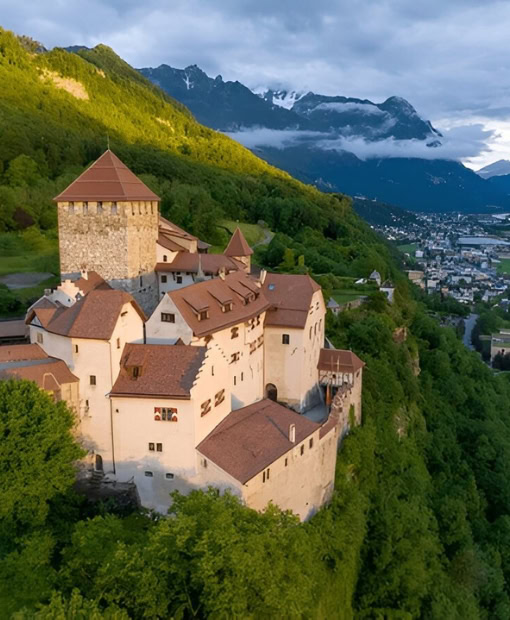
Yes — both Swisscom and Salt hold 4G at the castle and the old town below. The hiking trail to Fläscherberg climbs into LTE-only territory after the first kilometre, and the ridge above 1,400 metres loses signal in forested stretches.
How much data do I need for a weekend ski trip in Malbun?
Two to three gigabytes covers live weather updates, the LIEmobil bus app for shuttles to Vaduz, WhatsApp calls, and occasional navigation. Add another gigabyte if you plan to stream music on the lifts or upload photos from the slopes each evening.
Can I make WhatsApp calls in Liechtenstein on this eSIM?
Yes — WhatsApp voice and video calls work over the data connection. Swisscom and Salt both provide low-latency 4G and 5G in the Rhine valley, so call quality matches what you would get on Wi-Fi. Expect occasional drops in the high mountains where coverage thins.
How much data does the LIEmobil bus app use per day?
Around 10–20 megabytes for real-time schedules, route planning, and mobile ticket QR codes. The app refreshes arrival boards every few minutes and generates a new QR code for each journey, so it needs live data throughout your trip — Wi-Fi-only mode does not work for ticket validation.
Swisscom vs Salt Mobile coverage in Vaduz?
Swisscom offers 5G across the capital with speeds around 80–120 Mbps in the town centre. Salt Mobile provides strong 4G with slightly lower speeds. Both carriers cover the castle, pedestrian zone, and museums reliably. Swisscom has a slight edge in the mountains, but the difference is minimal in the valley.
Swisscom vs Salt Mobile coverage in the mountains?
Swisscom maintains 4G at Malbun ski resort and most alpine villages. Salt Mobile is thinner on upper slopes and high ridges — you may drop to LTE or lose signal in back bowls. For serious hiking or backcountry skiing, Swisscom is the safer choice.
Does the Telefonbuch.li directory app work on this eSIM?
Yes — the app loads business listings and contact details over your data connection. It uses minimal bandwidth, around 5–10 megabytes per day if you are looking up restaurants or services frequently. The app works identically to how it would on a local Swiss SIM.
Does the MeteoSwiss weather app work for Liechtenstein forecasts?
Yes — MeteoSwiss covers Liechtenstein with the same granularity as Swiss regions. The app pulls radar, hourly forecasts, and avalanche bulletins over your eSIM data. Expect around 20–30 megabytes per day if you refresh forecasts multiple times, more if you load animated radar loops.
eSIM vs buying a SIM card in Switzerland for a Liechtenstein trip?
A Swiss SIM from Swisscom or Salt works identically in Liechtenstein because the principality uses Swiss infrastructure. The eSIM skips the errand of visiting a shop in Buchs or Sargans, activates the second you cross the border, and does not require you to manage a physical card or return it when you leave.
Does the eSIM work across the border in Feldkirch, Austria?
Yes — Swisscom and Salt both provide cross-border coverage into Feldkirch without interruption. Your eSIM treats the border as a domestic handoff, so you stay online at the train station, the old town, and the shopping streets without a roaming charge or manual network switch.
Does the eSIM work across the border in Buchs, Switzerland?
Yes — Buchs sits in the Swiss network footprint that Liechtenstein shares. Your eSIM connects to Swisscom or Salt on both sides of the border with no roaming fee. The train station, Rheinpark mall, and the road to Sargans all hold 4G or 5G continuously.
Can I use the eSIM for hotspot to share data with my laptop?
Yes — hotspot is enabled by default. You can tether a laptop, tablet, or a companion's phone without throttling on the first few gigabytes. Useful if you are working remotely from a Vaduz café or sharing navigation with a travel partner whose device does not support eSIM.
Does the eSIM work on the train from Zurich to Liechtenstein?
Yes — the route from Zurich to Sargans and onward to Liechtenstein runs through Swiss network coverage. Swisscom and Salt both provide 4G or 5G along the entire rail corridor. You may drop to LTE briefly in tunnels, but the connection recovers within seconds of exiting.
Need broader coverage?
Going further than Liechtenstein? These plans include Liechtenstein plus everywhere in between.
Liechtenstein has no mobile network of its own — your phone connects to Swisscom or Salt Mobile, the same carriers that blanket Switzerland. A Liechtenstein eSIM hands you Swiss infrastructure the moment you cross the border from Feldkirch or Buchs, so the LIEmobil bus app works for real-time schedules and mobile ticket QR codes, and you stay online from Vaduz castle down to the Rhine valley without a second SIM or a roaming surcharge.
Choose your plan
8 options
Balanced use — social, navigation & light streaming
Choose number of eSIMs
How many travelers?
1 eSIM
Total$12.91
Secure payment
30-day guarantee
Telecom Liechtenstein AG5G
Features
Data-only plan, no contract
Works on 5G / 4G LTE networks
Choose when your plan activates
Connects to top local carriers
No physical SIM swap needed
24/7 customer support
Description
Landing in Zurich or Friedrichshafen and driving into Liechtenstein means your eSIM connects to Swisscom or Salt the moment you enter Swiss airspace or cross the Austrian border — there is no separate Liechtenstein carrier to wait for.
Installation takes one minute: scan the QR code esima emails you, confirm the new data plan in your phone's settings, and the network registers before you clear customs.
The principality's 160 square kilometres mean you will rarely lose signal in populated areas — Vaduz, Schaan, Balzers, and Triesen all sit in the Rhine valley where both carriers maintain dense tower grids.
Malbun, the ski resort at 1,600 metres, has 4G on Swisscom; the chairlifts and pistes stay connected, though the back bowls and off-piste zones can drop to LTE or lose service entirely.
Hiking trails above the tree line — Fürstensteig, the Drei Schwestern route — lose coverage in stretches where rock walls block line-of-sight to valley towers.
A physical SIM bought in Switzerland works identically because Liechtenstein uses Swiss infrastructure, but you would need to visit a Swisscom or Salt shop in Buchs or Sargans to collect it, then manage the swap and keep the plastic card for your return journey. The eSIM skips that errand and activates the second you need it.
Technical specs
Network
Telecom Liechtenstein AG5G
Coverage
Liechtenstein
Delivery
Immediate, by email
Plan type
Data only
Phone number
No
SMS / calls
VoIP apps only
Activation
QR code or manual SM-DP+
Why travelers choose Esima
Three reasons travellers pick esima for Liechtenstein. First: pricing mirrors Swiss prepaid rates, not the roaming markup your home carrier layers onto Swiss towers.
Second: the eSIM switches between Swisscom and Salt automatically, so you get the stronger signal whether you are in downtown Vaduz or the Malbun ski bowl. Third: hotspot is enabled from install — useful if you are travelling with a laptop for remote work or a partner whose device does not support eSIM.
No throttling after the first few gigabytes, unlike some Swiss carrier bundles that drop to 3G speeds once you hit a soft cap.
Instant delivery
Your QR code lands in your inbox minutes after purchase.
No roaming bills
Pay one upfront price — no surprise charges abroad.
Keep your number
Your physical SIM stays active for calls and texts.
Fast 4G/5G
Connect to top-rated local networks at full speed.
24/7 support
Real humans ready to help, any time zone, any day.
Easy install
Scan once and you're online — no app, no SIM swap.
Coverage in Liechtenstein
Swisscom provides the backbone — 5G across Vaduz, Schaan, and the valley floor, 4G at Malbun ski resort and most alpine villages. Salt Mobile offers similar footprint but thinner signal in the mountains.
The Fürstensteig hiking trail above Gaflei loses service in forested sections; download offline maps before you start. Cross-border coverage into Austria (Feldkirch) and Switzerland (Buchs, Sargans) carries over without interruption on both carriers — your eSIM treats the border as a domestic handoff.
Expect LTE-only or no signal in the deepest parts of the Rätikon range and along the high ridges toward the Three Sisters peaks. The Rhine valley corridor and all major roads hold 4G reliably.
Network
Telecom Liechtenstein AG5G
Good to know
LIEmobil bus app needs live data for mobile ticket QR codes — the driver scans your screen, so Wi-Fi-only mode does not work.
Cross-border coverage into Feldkirch (Austria) and Buchs (Switzerland) is automatic on Swisscom and Salt — no roaming charge, no manual network switch.
Download offline maps before hiking Fürstensteig or the Three Sisters route — forested sections above Gaflei lose signal for 30–60 minutes at a time.
Malbun ski resort has 4G on Swisscom but the back bowls drop coverage — cache your avalanche forecast and piste map before heading up the Sareis lift.
The Rhine valley corridor (Vaduz–Schaan–Balzers) holds 5G or strong 4G continuously — you will not lose signal on the main road or the train line into Switzerland.
Coverage in Liechtenstein — top cities
Vaduz
The capital sits in the valley with full 5G on Swisscom and strong 4G on Salt. The castle, pedestrian zone, and government quarter all hold signal. Indoor coverage in the Kunstmuseum and Postmuseum is reliable. Expect speeds around 80–120 Mbps in the town centre, faster near the Landtag building where tower density peaks.
Malbun
The ski resort has 4G on Swisscom across the village, chairlifts, and groomed runs. Salt Mobile is thinner — you may drop to LTE on the upper slopes. The Sareis chairlift and Schneeflucht run hold signal; the Augstenberg back bowl loses coverage in pockets. Download trail maps and avalanche bulletins before you leave the base lodge.
Balzers
The southern village has consistent 4G on both carriers. Gutenberg Castle, the old town, and the industrial zone near the Swiss border all stay connected. The hiking trail to Fläscherberg climbs into LTE-only territory after the first kilometre; the ridge above 1,400 metres loses signal intermittently where forest blocks tower line-of-sight.
How to set up your eSIM
1
Check compatibility
Make sure your phone supports eSIM — most recent models do.
2
Buy your eSIM
Pick a plan and pay securely. Your QR code arrives by email in minutes.
3
Scan & connect
Scan the QR code, enable data roaming on arrival, and you're online.
 WhatsApp +44 7367 063273