WhatsApp +44 7367 063273
Niamh F.
Galway, IE · Jun 2026
Reliable, but some hiccups
Overall, esima worked well in Belgium. The installation was straightforward, but I did face some signal issues in rural areas. The speed was decent in cities like Ghent, though.
98 verified reviews
Based on 98 reviews
Niamh F.
Galway, IE · Jun 2026
Overall, esima worked well in Belgium. The installation was straightforward, but I did face some signal issues in rural areas. The speed was decent in cities like Ghent, though.
Priya S.
Mumbai, IN · Jun 2026
The eSIM worked well throughout my stay in Belgium, especially in urban areas. Scanning the QR code made activation easy. I did notice some slower speeds in remote areas, but it was still a better option than traditional roaming.
Sophie W.
Toronto, CA · May 2026
I just scanned the QR code upon landing at Brussels Airport and was online in seconds! The 5G speed was fantastic, allowing me to stream Netflix without any buffering. Highly recommend esima for anyone traveling to Belgium!
Elena G.
Madrid, ES · May 2026
Getting set up in Brussels was a breeze! Scanned the QR code and I had 5G in seconds. Streaming Netflix at the hotel was smooth. Highly recommend this eSIM!
Jordan A.
Johannesburg, ZA · May 2026
Used esima during my trip across Brussels, Ghent, and Antwerp. The 4G speed was reliable, and I never had issues with coverage. Installation was a breeze, and I was online in no time!
Aoife N.
Cork, IE · May 2026
Used esima during my trip to Bruges and Ghent. The install process was quick, and I appreciated the user-friendly app. The only downside was some slow speeds in the countryside, but overall, a solid choice for travelers.
Ethan O.
Dublin, IE · May 2026
I used esima while traveling through Brussels and Ghent, and I found the coverage to be excellent. I appreciated the straightforward setup and the ability to stay connected without buying a local SIM. Just a few hiccups with speed in very remote areas, but nothing major.
Sophie W.
Toronto, CA · May 2026
I was pleasantly surprised by how easy it was to set up the esima eSIM. Just 30 seconds to scan the QR code and I was online. Perfect for navigating around Ghent!
Typical home-carrier roaming
£10–£20
per day
Esima eSIM
£2.57
Flat rate
Most international carriers charge a flat daily fee for Belgium roaming, usually capped after the first gigabyte or two — speeds throttle to 2G after that limit, which breaks live ticket validation and navigation.
Hotspot is often blocked or costs extra on roaming plans, so you cannot share data with a laptop or a travel partner. The daily fee stacks every calendar day your phone touches a Belgian tower, even if you only use ten megabytes.
An eSIM gives you a fixed data pool at local-market pricing with no daily recurrence, no throttling, and hotspot enabled by default. You pay once, use what you need, and the cost stays flat whether you are in Belgium for three days or three weeks.
Roaming bundles from major networks often exclude app-based ticket validation or require you to disable data roaming between uses, which means you miss notifications and have to toggle settings every time you open the metro app.
Different trip, same eSIM — here is how it lands for the most common visitors to Belgium.
You are moving between Brussels, Bruges, Antwerp and Ghent over five days. The eSIM keeps NMBS/SNCB mobile tickets active for conductor scans, loads museum maps in real time, and lets you hotspot your tablet in a Ghent café to edit photos. No SIM swap, no roaming fees, no throttling after the first gigabyte.
Art-city hopper
You are hiking the GR trails near La Roche-en-Ardenne and Durbuy. The eSIM gives you 4G on main roads and 3G in valleys, enough to check trail maps and weather updates. You download offline maps in Brussels before departure, then rely on the eSIM for emergency contact and lodge bookings.
Ardennes hiker
You are in Brussels for three days of meetings in the European Quarter. The eSIM connects you to Proximus 5G at the airport, keeps Outlook syncing on the metro, and lets you hotspot your laptop in the hotel without paying the conference-center Wi-Fi fee. STIB/MIVB tickets validate instantly at Schuman station.
Business traveler
The apps locals and travelers actually use — the ones that need real cell data, not just hotel Wi-Fi.
STIB/MIVB
Brussels metro, tram and bus tickets with QR validation at gates

NMBS/SNCB
National rail tickets and live train schedules

Uber
Rideshare in Brussels and Antwerp

Bolt
Rideshare and scooter rental in Brussels

Payconiq by Bancontact
Mobile payments at shops, restaurants and markets
Google Maps
Navigation and public-transport routing
Velo Antwerpen / Blue-bike
Bike-share rental and docking-station maps
~40MB per day for text and voice calls, ~120MB per day with video calls and photo sharing.
Maps
~80MB per day for live navigation in Brussels, Bruges or Antwerp; less if you cache offline maps before trips to the Ardennes.
Rideshare
~15MB per day for Uber or Bolt in Brussels — includes live driver tracking and route updates.
Yes. Bruges city center has full 4G and 5G coverage on Proximus, Orange Belgium and Base. The Markt, the Belfry, the canal district and the train station all have strong signal. If you cycle out to Damme or the coast, coverage holds steady across the flat Flemish countryside.
Orange Belgium covers most of the Ardennes forest with 4G, but valleys near La Roche-en-Ardenne thin to 3G. Proximus and Base (which shares Proximus towers) have similar coverage. Download offline maps before you leave Brussels if you are hiking or driving deep into the forest.
Yes, but expect patchy LTE in tunnels south of Charleroi on the Thalys route. Coverage is strong at Brussels-Midi and holds through most of Belgium, then drops briefly in the cross-border tunnels. Download your boarding pass and any maps before departure.
Two to three gigabytes covers a week of maps, STIB/MIVB and NMBS/SNCB ticket apps, WhatsApp and light browsing. Add another gigabyte if you are using rideshare apps daily or posting photos. Hotspot for a laptop adds roughly 500MB per day of casual use.
Yes. WhatsApp voice and video calls work over the eSIM data connection on all three Belgian networks. Quality is strong in cities and along motorways, and thins slightly in the Ardennes valleys where 4G drops to 3G.
Yes. The STIB/MIVB app needs live data to generate and validate QR ticket codes at Brussels metro and tram gates. The eSIM provides that connection on all carriers. Paper tickets cost more at kiosks, so the app saves you money and queue time.
Proximus has denser 5G in Brussels, especially around Gare Centrale, the European Quarter and the airport. Orange Belgium covers the city with 4G and some 5G. Both work well for metro tickets and navigation; Proximus edges ahead on speed in the city center.
Orange Belgium has stronger 4G coverage in the Ardennes forest, though valleys near La Roche-en-Ardenne thin to 3G on all carriers. Proximus and Base (which shares Proximus towers) have similar rural footprints. All three work for navigation on main roads.
Yes. The NMBS/SNCB app requires live data to purchase mobile tickets and for conductor scanning. The eSIM keeps the connection active on platforms and trains (except in some tunnels). Paper tickets cost more and require queuing at station kiosks.
Uber operates in Brussels and Antwerp but is restricted in other cities. The app needs live data to request rides and track drivers. Bolt is also available in Brussels. Both work over the eSIM on all three Belgian carriers.
An airport SIM from Proximus or Orange costs around twenty to thirty euros for a week, requires a passport photocopy, and ties you to one carrier. The eSIM costs less, switches between carriers automatically for the best signal, and activates in thirty seconds with no paperwork or kiosk queue.
Yes. Brussels Airport has full 5G coverage from Proximus and 4G from Orange Belgium and Base. Your eSIM will register before you leave the arrivals hall, so you can open maps, call a rideshare or buy a train ticket immediately.
Yes. Ghent has full 4G and 5G coverage from all three carriers. Proximus leads on 5G density in the city center and around Sint-Pietersstation. Orange Belgium and Base both deliver strong 4G. Signal holds steady along the canals and in the Gravensteen area.
Yes. Hotspot is enabled by default on esima eSIMs. You can tether a laptop, tablet or another phone without extra cost or throttling. Useful in Ghent cafés, Brussels coworking spaces or on the train between cities.
Yes. The Belgian coast from De Panne to Knokke has full 4G and 5G coverage on all three carriers. Proximus and Orange both cover the beach towns, the tram line and the dunes. Signal holds steady along the entire coastline.
Going further than Belgium? These plans include Belgium plus everywhere in between.
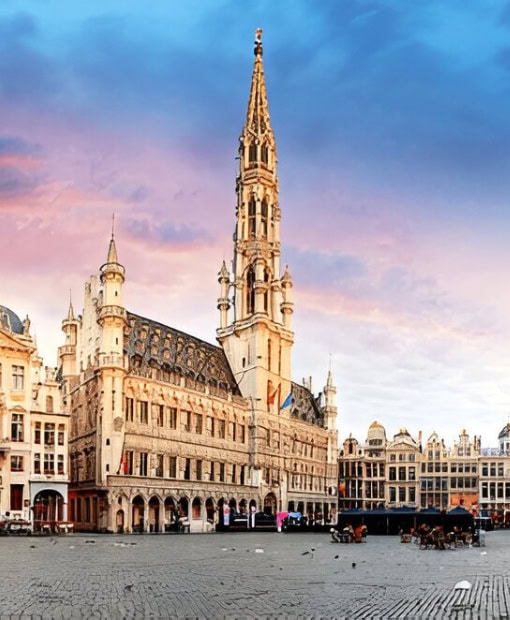

Belgium runs on mobile tickets — STIB/MIVB metro gates in Brussels scan QR codes from your phone, NMBS/SNCB conductors validate rail passes live, and paper tickets cost more at the kiosk. A Belgium eSIM connects you to Proximus, Orange Belgium or Base the moment you land at Zaventem, so you skip the airport SIM queue and the €15-per-day roaming bill your home carrier wants to charge.
Balanced use — social, navigation & light streaming
How many travelers?
You land at Brussels Airport, scan the eSIM QR code esima sent by email, and you are online before the baggage carousel starts turning. Installation takes thirty seconds — iOS and Android both walk you through adding the profile, then you toggle it on under Settings > Cellular.
The eSIM registers on whichever Belgian network has the strongest signal at your location, usually Proximus in Brussels or Antwerp, Orange in the south. No SIM-ejector tool, no passport photocopy at a Proximus shop, no €20 deposit.
You open the STIB/MIVB app, buy a metro ticket, and the QR code scans at the Gare Centrale gates without delay. The same flow works for NMBS/SNCB rail tickets — conductors scan your phone, the app pings the server, you are validated.
Hotspot works out of the box, so your laptop can tether in a Ghent café or your partner's non-eSIM phone can share your data. The eSIM stays active across all three regions — Flanders, Wallonia, Brussels-Capital — and does not care which language your phone is set to.
Coverage holds steady in every major city and along the motorway network; it thins in the Ardennes valleys and drops briefly in rail tunnels, but returns fast.
Compared to a physical SIM from a Proximus or Orange shop, the eSIM saves you the queue, the paperwork, and the need to return the SIM card when you leave. You delete the profile from your phone settings when your trip ends, and the line deactivates automatically.
Three reasons travelers pick esima for Belgium. First: pricing mirrors local prepaid rates, not roaming markup — you pay what a Belgian customer pays for the same Proximus or Orange tower.
Second: the eSIM switches between carriers automatically, so you get the strongest signal in Bruges or the Ardennes rather than one network's blind spot. Third: hotspot is enabled by default — useful if you are traveling with a laptop or a partner whose phone does not support eSIM. No throttling after the first gigabyte like some Belgian carrier prepaid deals.
Your QR code lands in your inbox minutes after purchase.
Pay one upfront price — no surprise charges abroad.
Your physical SIM stays active for calls and texts.
Connect to top-rated local networks at full speed.
Real humans ready to help, any time zone, any day.
Scan once and you're online — no app, no SIM swap.
Our Belgium eSIMs run on Proximus, Orange Belgium and Base (Telenet). Proximus has the densest 5G footprint in Brussels, Antwerp and Ghent, plus along the E40 motorway corridor between the capital and the coast.
Orange Belgium covers the Ardennes forest with 4G, but valleys near La Roche-en-Ardenne thin to 3G. Base shares Proximus infrastructure in rural Wallonia, so coverage mirrors Proximus maps in those regions.
Bruges city center and the coast from De Panne to Knokke have full 4G and 5G on all three carriers. Brussels Airport and Gare du Midi have full 5G; cross-border Thalys trains to Paris have patchy Belgian LTE in tunnels south of Charleroi.
Expect signal to drop briefly in the deeper Ardennes valleys and on some stretches of the E25 between Liège and Luxembourg.
Network
Make sure your phone supports eSIM — most recent models do.
Pick a plan and pay securely. Your QR code arrives by email in minutes.
Scan the QR code, enable data roaming on arrival, and you're online.