WhatsApp +44 7367 063273
Michael R.
Los Angeles, US · May 2026
Seamless in Sarajevo
Activated the eSIM as soon as I landed in Sarajevo by simply scanning the QR code. Fast 4G speeds allowed me to navigate and stream music easily throughout my trip!
31 verified reviews
Based on 31 reviews
Michael R.
Los Angeles, US · May 2026
Activated the eSIM as soon as I landed in Sarajevo by simply scanning the QR code. Fast 4G speeds allowed me to navigate and stream music easily throughout my trip!
Daniel J.
Sydney, AU · Mar 2026
Using the esima eSIM in Sarajevo was a breeze. Installation took just a minute, and I had great coverage while exploring the city. The only downside was slightly slower speeds in the mountains, but overall a solid choice for travelers.
Charlotte F.
Montreal, CA · Feb 2026
The esima eSIM worked perfectly as soon as I landed in Sarajevo. I scanned the QR code, and within 30 seconds, I was connected. The 4G speed was impressive, allowing me to stream videos and navigate without any issues.
Sven A.
Stockholm, SE · Feb 2026
While the esima eSIM worked well in major cities like Mostar, I faced some connectivity issues while hiking in the mountains. The installation was straightforward via QR scan, but I expected more consistent service. Overall, decent but could improve.
Arjun K.
Bangalore, IN · Feb 2026
I loved using the esima eSIM during my travels in Bosnia and Herzegovina. Setup was quick, and I never had to worry about finding Wi-Fi. The only minor issue was a few weak spots in the countryside, but generally, it was a great experience.
Anna V.
Amsterdam, NL · Dec 2025
The eSIM worked well most of the time, but I experienced frustrating slow speeds in rural areas of Bosnia. Installing it was straightforward, but I struggled with the app a bit. It served its purpose, but I had hoped for better performance overall.
Aoife N.
Cork, IE · Nov 2025
The esima eSIM worked perfectly during my trip to Bosnia and Herzegovina. I was connected as soon as I scanned the QR code at the airport, and I enjoyed uninterrupted 5G speeds even in remote areas like Mostar. Highly recommend!
Jessica L.
New York, US · Aug 2025
The esima eSIM made my trip to Bosnia a breeze! I set it up in under a minute and had reliable 4G coverage in both urban and rural areas. Customer service was also super helpful when I had a question.
Typical home-carrier roaming
£10–£18
per day
Esima eSIM
£3.43
Flat rate
Most international carriers treat Bosnia and Herzegovina as a non-EU Balkan destination, so roaming bundles throttle after the first gigabyte or two and charge per-day fees that stack quickly over a week. Hotspot and tethering are often disabled or cost extra on roaming plans.
The eSIM gives you a flat data allowance at local-market pricing — no throttling, no daily caps, no surprise overage bill when you return home.
If you are crossing entity lines between the Federation and Republika Srpska, some home-carrier roaming plans treat that as a new country and trigger a second daily fee; the eSIM sees it as domestic handoff.
You keep your primary number active for two-factor codes and incoming calls, but data and outbound calls run through the local network at prepaid rates rather than roaming rates.
Different trip, same eSIM — here is how it lands for the most common visitors to Bosnia and Herzegovina.
You drive the M17 motorway from Sarajevo to Mostar, then cut east toward Trebinje and the Montenegrin border. The eSIM hands you BH Telecom on the motorway, m:tel in Trebinje, and keeps Google Maps live through entity crossings. You upload photos from the Old Bridge without hunting for café Wi-Fi.
Balkan road-tripper
You spend three days in Sarajevo visiting the Tunnel Museum, the Latin Bridge, and Baščaršija, then take a day trip to Jajce. The eSIM keeps WhatsApp and maps running in the city and on the drive. You buy paper tram tickets at kiosks because Sarajevo has no mobile ticketing app yet.
History-focused traveler
You work mornings from a Sarajevo café, then explore Mostar and Banja Luka on weekends. The eSIM's hotspot lets you tether your laptop without paying for hotel upgrades. You stay online through entity crossings and avoid the roaming fees your home carrier would charge for a two-week stay.
Remote worker on a Balkan loop
The apps locals and travelers actually use — the ones that need real cell data, not just hotel Wi-Fi.
Bolt
Rideshare in Sarajevo and select cities
Google Maps
Navigation and offline maps for motorways and mountain roads
Messaging and voice calls with local guesthouses and tour operators

Raiffeisen ELBA
Mobile banking for Raiffeisen Bank customers in Bosnia and Herzegovina

BH Pošta
Postal tracking and bill payment for Bosnia and Herzegovina Post
Around fifty megabytes per day for text and photos, one hundred fifty megabytes per day if you make voice calls to guesthouses or tour operators.
Maps
One hundred to one hundred fifty megabytes per day for active turn-by-turn navigation on the M17 motorway or Sarajevo streets. Download offline maps to cut that in half.
Rideshare
Bolt uses five to ten megabytes per ride in Sarajevo. Traditional taxis are more common outside the capital, so rideshare data is minimal unless you stay in the city.
Winter (December through February) brings snow to the Dinaric highlands and can close secondary mountain roads, reducing the need for live navigation data outside the M17 corridor and major cities.
Summer (June through August) sees the highest tourist volume in Mostar and Sarajevo, which can congest cell towers near the Old Bridge and Baščaršija during midday. Spring and autumn offer the most stable coverage because fewer travelers share the network and weather does not disrupt rural tower access.
Yes, but coverage drops to 3G or edge in spots, especially near the Neretva gorge and at Blagaj Tekke. BH Telecom and HT Eronet hold 4G along the main boulevards and the bus station. Download offline maps before leaving the M17 motorway corridor if you are driving toward Kravica or Počitelj.
Yes. M:tel dominates Republika Srpska, so Banja Luka sees solid 4G across Krajina Square, the Kastel Fortress, and the university district. BH Telecom and HT Eronet are present but weaker. The eSIM will hand you off to m:tel automatically when you cross from the Federation.
Jajce town has 4G on BH Telecom, but rural roads toward Travnik are LTE-only and other carriers thin out faster. The waterfalls and lakeside trails have patchy coverage. Download offline maps before leaving the main road if you are hiking or driving secondary routes.
Yes. The M17 has continuous 4G on BH Telecom and HT Eronet. M:tel is patchy south of Konjic. This is the most reliable data corridor in the country — coverage quality drops fast once you leave the motorway toward smaller towns or mountain roads.
Three to five gigabytes covers a week of navigation, WhatsApp, and occasional photo uploads. If you are streaming music on long drives or uploading video from Mostar or Jajce, budget seven to ten gigabytes. Sarajevo's cafés and hotels offer free Wi-Fi, so you can offload heavy downloads there.
Yes. WhatsApp voice and video calls work over the eSIM's data connection. Quality depends on signal strength — expect clear calls in Sarajevo, Mostar, and Banja Luka, but choppy audio in rural areas or near the Neretva gorge where coverage drops to 3G.
Active turn-by-turn navigation uses around one hundred to one hundred fifty megabytes per day. If you are driving the M17 motorway or exploring Sarajevo on foot, download offline maps before leaving your hotel to cut that in half and ensure navigation works in dead zones.
BH Telecom and HT Eronet both deliver strong 4G across Baščaršija, the Latin Bridge, and Marijin Dvor. M:tel is present but weaker in the Federation capital. The eSIM will pick BH Telecom or HT Eronet automatically when you are in Sarajevo.
M:tel dominates Republika Srpska — Banja Luka sees solid 4G on m:tel across the city center, Kastel Fortress, and university district. BH Telecom and HT Eronet are present but weaker. The eSIM will hand you off to m:tel when you cross from the Federation into Republika Srpska.
Sarajevo's GRAS tram and trolleybus system has no official mobile ticketing app as of 2024. You buy paper tickets at kiosks or from the driver. The eSIM will not help here — the city has not deployed a digital ticketing system yet.
Yes. Bolt operates in Sarajevo and a few other cities. The app needs live data to request rides and track drivers. The eSIM provides that connection. Traditional taxis are more common outside Sarajevo, and you will hail them on the street or call a dispatcher.
Physical SIMs from BH Telecom or m:tel are sold at post offices and kiosks, but activation can take an hour and requires a local address on the registration form. The eSIM installs in under a minute, skips the paperwork, and gives you the same network access. If you are only in the country for a few days, the eSIM is faster and simpler.
Yes. Cross-entity travel from the Federation into Republika Srpska can trigger domestic roaming on some prepaid plans, but the eSIM handles that handoff automatically because it is provisioned for all three carriers. You will not see a service interruption or an extra charge.
Yes. Trebinje is in Republika Srpska, so m:tel has the strongest coverage. BH Telecom and HT Eronet are present but weaker. The eSIM will hand you off to m:tel automatically. Expect 4G in the town center and along the main roads, but coverage thins toward the Montenegrin border.
Yes. Hotspot and tethering are enabled by default. You can share the eSIM's data connection with a laptop, tablet, or travel partner. No throttling on the first few gigabytes like some local carrier deals. Useful if you are working remotely from a Sarajevo café or a Mostar guesthouse.
Going further than Bosnia and Herzegovina? These plans include Bosnia and Herzegovina plus everywhere in between.
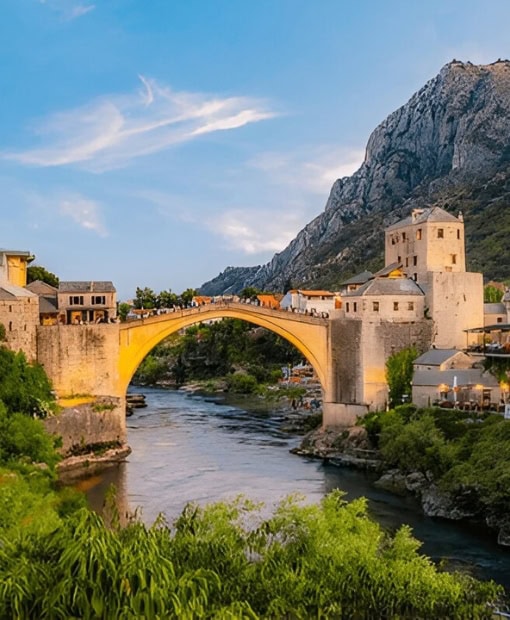
Bosnia and Herzegovina runs on three carriers split by entity lines, paper tram tickets in Sarajevo, and a motorway corridor where 4G holds until you veer toward the Neretva gorge. An eSIM locks you into BH Telecom, HT Eronet, or m:tel the moment you scan the QR code in your hotel, so you skip the hunt for a physical SIM counter and the entity-roaming fine print that can surprise prepaid users crossing from Sarajevo to Banja Luka.
Balanced use — social, navigation & light streaming
How many travelers?
You land at Sarajevo International, scan the eSIM QR code in the arrivals hall or your taxi, and the profile installs in under a minute. The phone picks BH Telecom or HT Eronet depending on which tower is stronger at that moment.
No counter queue, no passport photocopy, no minimum top-up. The eSIM behaves like a local prepaid SIM — data, voice, and SMS all work — but you keep your primary number active for two-factor codes and incoming calls.
Cross-entity travel from the Federation into Republika Srpska can trigger domestic roaming on some prepaid plans; the eSIM handles that handoff automatically because it is provisioned for all three carriers. Sarajevo's GRAS tram and trolleybus system still sells paper tickets as of 2024, so you will not find an official mobile-ticketing app.
The M17 motorway corridor between Sarajevo and Mostar is the most reliable data route in the country; once you leave that spine toward smaller towns or the mountains, coverage quality depends on which carrier the eSIM selects.
Physical SIMs from BH Telecom or m:tel are sold at post offices and kiosks, but activation can take an hour and requires a local address on the registration form. The eSIM skips that paperwork entirely and gives you the same network access within seconds of arrival.
Three reasons travelers pick esima for Bosnia and Herzegovina. First: pricing mirrors local prepaid rates, not the per-day roaming tariff your home network charges for a Balkan tower.
Second: the eSIM hands you the strongest signal at each location — BH Telecom in Sarajevo, m:tel in Banja Luka — rather than locking you to a single carrier that thins out when you cross entity borders.
Third: hotspot and tethering work out of the box, essential if you are traveling with a laptop or sharing data with a partner whose phone does not support eSIM.
Your QR code lands in your inbox minutes after purchase.
Pay one upfront price — no surprise charges abroad.
Your physical SIM stays active for calls and texts.
Connect to top-rated local networks at full speed.
Real humans ready to help, any time zone, any day.
Scan once and you're online — no app, no SIM swap.
Our Bosnia and Herzegovina eSIMs run on BH Telecom, HT Eronet, and m:tel. BH Telecom has the strongest footprint in the Federation entity — Sarajevo, Mostar, and Tuzla all see solid 4G in city centers.
M:tel dominates Republika Srpska, so Banja Luka and Trebinje perform better on that network. The M17 motorway between Sarajevo and Mostar holds continuous 4G on BH Telecom and HT Eronet; m:tel thins south of Konjic.
Mostar's Old Town and Blagaj Tekke drop to 3G or edge in spots, especially near the Neretva gorge. Jajce town has 4G, but rural roads toward Travnik are LTE-only on BH Telecom.
No carrier offers 5G consumer service as of early 2026. Expect dead zones in the Dinaric highlands and along secondary mountain roads.
Network
Make sure your phone supports eSIM — most recent models do.
Pick a plan and pay securely. Your QR code arrives by email in minutes.
Scan the QR code, enable data roaming on arrival, and you're online.