WhatsApp +44 7367 063273
Jordan A.
Johannesburg, ZA · Jun 2026
Easy setup and great speed
Setting up the eSIM was a breeze! I used the QR code in just a minute, and I was streaming Netflix without a hitch in Tunis. Highly recommend for anyone traveling to Tunisia.
93 verified reviews
Based on 93 reviews
Jordan A.
Johannesburg, ZA · Jun 2026
Setting up the eSIM was a breeze! I used the QR code in just a minute, and I was streaming Netflix without a hitch in Tunis. Highly recommend for anyone traveling to Tunisia.
Jessica L.
New York, US · May 2026
I was impressed with how quickly the esima eSIM connected once I scanned the QR code at Tunis-Carthage Airport. The 5G speeds were perfect for sharing travel updates and searching for local spots. This made my trip so much easier!
Jessica L.
New York, US · May 2026
While I appreciated the ease of installation with the QR code, I experienced some service interruptions in rural areas. The customer support was helpful, but I expected a bit more consistency, especially for the price.
Niamh F.
Galway, IE · May 2026
Used esima during my trip across Tunisia, from Tunis to Sousse. The service was mostly reliable, though there were a couple of spots in the desert where coverage dropped. Still, the speed was great in urban areas!
Jordan A.
Johannesburg, ZA · May 2026
Used esima in Tunis and Sousse, and the speed was impressive. Sometimes I had to manually toggle settings for the best results, but overall a solid experience. Customer service was responsive when I had questions about installation!
Marco D.
Rome, IT · May 2026
Setting up the esima eSIM was straightforward. The QR code scan took less than a minute. However, I did experience some slow speeds in more rural areas outside of Tunis. Overall, a solid choice for travelers!
Sven A.
Stockholm, SE · Apr 2026
I was nervous about using an eSIM, but esima made everything so simple. I had a strong 5G connection in Tunis and got to share my trip instantly with friends. The installation took less than a minute. Totally worth it!
Michael R.
Los Angeles, US · Apr 2026
Using the esima eSIM in Tunisia was a great decision. I appreciated the flexibility it gave me compared to traditional roaming. The setup took just under a minute, and the service was solid in most areas, although I did experience a bit of lag at times. Still, it’s a fantastic option!
Typical home-carrier roaming
£10–£18
per day
Esima eSIM
£2.57
Flat rate
Most international carriers charge per-day roaming fees for Tunisia, and those fees stack every calendar day your phone connects to a local tower — even if you only check email once. Many roaming bundles throttle speeds after the first gigabyte or two, and hotspot is often blocked entirely or costs extra.
The eSIM gives you a flat data allowance at local prepaid rates, no daily fee, and hotspot enabled by default. If you are in Tunisia for a week, the math tips heavily toward the eSIM.
Roaming also locks you to whichever Tunisian carrier your home network has a wholesale agreement with, which may not be the strongest in Hammamet or Djerba. The eSIM hands off between Tunisie Telecom, Ooredoo Tunisia, and Orange Tunisia automatically, so you get the best available signal at each location.
Different trip, same eSIM — here is how it lands for the most common visitors to Tunisia.
You spend your days navigating the Tunis and Sfax medinas, calling Bolt for rides back to your riad, and messaging your tour guide on WhatsApp. The eSIM keeps Google Maps live when you turn down an unmarked alley, and hotspot lets your partner check restaurant reviews without buying a second SIM.
Medina explorer
You fly into Tunis, take the train to Tozeur, and join a three-day desert tour to Chott el Djerid and Ksar Ghilane. The eSIM works in Tozeur for last-minute bookings and lets you download offline maps before the tour. You have no signal in the Sahara, but the eSIM reconnects the moment you return to Tozeur.
Sahara tour participant
You stay in Hammamet or Sousse, book day trips to Djerba and Sidi Bou Said, and use InDrive for rides between the beach and the medina. The eSIM gives you LTE along the entire coast, lets you upload photos from the resort pool, and tethers your tablet for evening Netflix without hunting for hotel Wi-Fi passwords.
Coastal resort traveler
The apps locals and travelers actually use — the ones that need real cell data, not just hotel Wi-Fi.

Bolt
Ride-hailing in Tunis, Sousse, and Sfax

InDrive
Ride-hailing with negotiable fares in Tunis, Sousse, and Sfax
Google Maps
Navigation in medinas, coastal roads, and between cities

Messaging and voice calls with hotels, tour operators, and contacts

TunisAir
Mobile boarding passes and flight status for domestic and regional flights

XE Currency
Real-time TND exchange rates and currency conversion
~50MB per day for chats and photos, ~150MB per day if you make voice calls to hotels or tour guides.
Maps
~5MB per hour of active turn-by-turn navigation in Tunis, Sousse, or along the coast; cache offline maps for the Sahara.
Rideshare
~2-5MB per Bolt or InDrive ride for driver matching, GPS tracking, and map rendering; budget 15-20MB per day if you take multiple rides.
Summer (June to August) brings peak tourist season to Hammamet, Sousse, and Djerba, and network congestion can slow speeds in resort zones during evening hours when everyone uploads photos. Ramadan shifts daily rhythms — restaurants and shops close during daylight hours, and mobile data usage spikes after iftar when families video-call relatives.
If you are traveling during Ramadan, expect slower speeds in the early evening in Tunis and Sfax as the network handles the surge. Winter (December to February) is low season; coverage quality remains the same, but you will face fewer congestion slowdowns in tourist areas.
Yes. Houmt Souk and the resort zones along the northeast coast have reliable LTE from all three carriers. The island's interior — the road to Guellala and the lagoon areas — drops to 3G. The causeway to the mainland has continuous LTE. Download offline maps before exploring the interior villages.
No. The Sahara Desert south of Douz and Tozeur has no mobile coverage from any carrier. Tours to Chott el Djerid and Ksar Ghilane require offline navigation. Download your maps, routes, and any travel documents in Tozeur before heading into the desert.
Intermittently. SNCFT trains on the Tunis-Sousse coastal line have intermittent LTE coverage and no onboard Wi-Fi. You will have signal in stations and near coastal towns, but expect dead zones between stops. Download podcasts, videos, or offline maps before boarding.
Three to five gigabytes covers most week-long trips. Google Maps uses around 5MB per hour of active navigation. WhatsApp chats are light, but voice calls add up to 150MB per day. Bolt and InDrive use minimal data per ride. If you plan to upload photos or stream video, add two to three gigabytes.
Yes. WhatsApp voice and video calls work over the eSIM's data connection. Voice calls use roughly 600KB per minute; video calls use around 4MB per minute. The eSIM does not include a Tunisian phone number, so you cannot make traditional cellular calls, but all internet-based calling apps work normally.
Yes. Bolt operates in Tunis, Sousse, and Sfax and needs live data for driver matching and real-time tracking. The app uses around 2-5MB per ride. Make sure you have active data before requesting a ride; pre-booking on hotel Wi-Fi will not work because the driver needs to reach you in real time.
Both carriers have full LTE coverage along the Hammamet resort strip and in the town center. Tunisie Telecom has slightly wider coverage inland toward Nabeul and along the Cap Bon coast. The eSIM hands off between both networks automatically, so you get the stronger signal at each location without manual switching.
Both have strong LTE in central Sfax, the port area, and the medina. Tunisie Telecom has better coverage on the roads south toward Gabès and inland toward Kairouan. Orange Tunisia is reliable within the city limits. The eSIM will connect to whichever network is stronger where you are standing.
Yes. InDrive operates in Tunis, Sousse, and Sfax and needs live data for driver matching and GPS tracking. The app uses around 2-5MB per ride. You need active data when you request the ride and while the driver is en route; the app will not function on cached data or offline mode.
The eSIM saves you the airport queue, the passport photocopy, and the risk of losing a physical card. Airport SIM kiosks in Tunis-Carthage sell prepaid plans from Tunisie Telecom, Ooredoo Tunisia, or Orange Tunisia, but you are locked to one carrier's coverage. The eSIM hands off between all three automatically. Pricing is similar; the eSIM is faster to activate and harder to lose.
Yes. Sidi Bou Said is 20 kilometers north of Tunis and has full LTE coverage from all three carriers. The cliffside cafés and the marina have strong signal. The TGM light rail from Tunis to Sidi Bou Said has continuous LTE along the route.
Yes. Kairouan has LTE coverage from Tunisie Telecom and Ooredoo Tunisia in the city center and around the Great Mosque. Signal thins on the roads between Kairouan and Sousse or Sfax. Download offline maps if you are driving between cities.
Yes, and you should. The Sahara Desert south of Douz and Tozeur has no mobile coverage. Download the offline map area in Google Maps while you are still in Tozeur. The offline map includes roads, landmarks, and basic navigation, but it will not show real-time traffic or alternate routes.
Yes. The Hammamet medina has LTE coverage from all three carriers, though thick stone walls can block signal indoors in shops and riads. Step outside or move closer to a window if you need to load a map or call a ride. The resort strip and beach promenade have full outdoor coverage.
Around 2-5MB per ride for driver matching, real-time GPS tracking, and map rendering. If you take three or four rides per day, budget 15-20MB. The app needs live data when you request the ride and while the driver is en route; it will not work offline.
Going further than Tunisia? These plans include Tunisia plus everywhere in between.
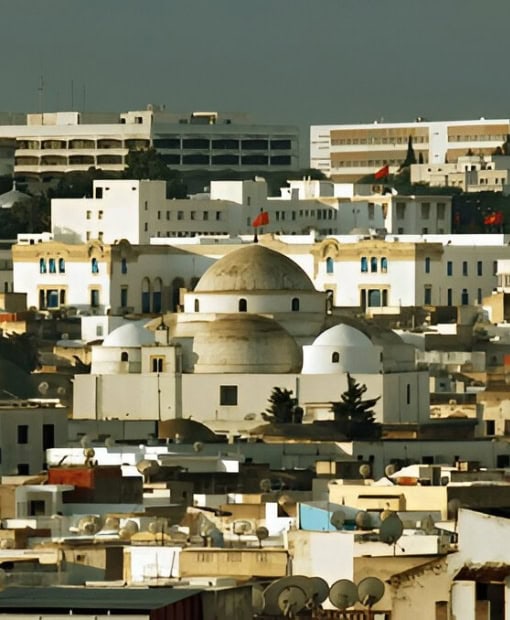

Tunisia runs on your phone — Bolt and InDrive for rides in Tunis and Sousse, Google Maps for the medina maze, WhatsApp for your riad host. A Tunisia travel eSIM drops you onto Tunisie Telecom, Ooredoo Tunisia, or Orange Tunisia the moment you land at Tunis-Carthage, so you skip the airport SIM counter, the passport photocopy, and the roaming bill that climbs every time you refresh Instagram in Sidi Bou Said.
Balanced use — social, navigation & light streaming
How many travelers?
You scan the QR code before you board your flight to Tunis, the eSIM profile installs in Settings, and the network activates when your plane touches down at Tunis-Carthage. The airport terminals have 4G coverage from all three carriers; you will be online before you reach passport control.
Installation takes two minutes if you follow the in-app steps — iOS and Android handle it identically. The eSIM behaves like a local Tunisian prepaid plan: you get a data allowance, no Tunisian phone number, and the ability to tether other devices.
Compared to a physical SIM from an airport kiosk, the eSIM saves you the queue, the passport photocopy, and the risk of losing a tiny plastic card in your bag.
The network hands off between Tunisie Telecom, Ooredoo Tunisia, and Orange Tunisia based on signal strength, so you are not locked to one carrier's coverage map. Hammamet and Sousse resort strips have full LTE; the medinas in Tunis and Sfax have dense coverage but stone walls can block signal indoors.
Bolt and InDrive operate in Tunis, Sousse, and Sfax for ride-hailing and need live data for driver matching. If you are heading to the Sahara, download offline maps in Tozeur — the desert south of Douz has no towers.
Three reasons travelers pick esima for Tunisia. First: pricing mirrors local prepaid rates, not the roaming markup your home carrier adds for North African towers.
Second: the eSIM hands off between Tunisie Telecom, Ooredoo Tunisia, and Orange Tunisia automatically, so you get the strongest signal in Hammamet's resort strip rather than a single carrier's gap.
Third: hotspot is enabled by default — useful if you are traveling with a laptop, a tablet, or a partner whose phone does not support eSIM. No throttling after the first gigabyte like some Tunisian tourist SIM deals.
Your QR code lands in your inbox minutes after purchase.
Pay one upfront price — no surprise charges abroad.
Your physical SIM stays active for calls and texts.
Connect to top-rated local networks at full speed.
Real humans ready to help, any time zone, any day.
Scan once and you're online — no app, no SIM swap.
Our Tunisia eSIMs run on Tunisie Telecom, Ooredoo Tunisia, and Orange Tunisia. Tunisie Telecom has the widest 4G footprint along the coast from Tunis to Djerba and inland to Kairouan.
5G is limited to central Tunis business districts; everywhere else you will land on LTE. Djerba Island has reliable LTE from all three carriers in Houmt Souk and the resort zones, but the interior drops to 3G.
The Sahara Desert south of Douz and Tozeur has no mobile coverage — tours to Chott el Djerid and Ksar Ghilane require offline navigation. The Cap Bon peninsula's eastern coast has signal gaps between towns.
SNCFT trains on the Tunis-Sousse coastal line have intermittent LTE; there is no onboard Wi-Fi.
Network
Make sure your phone supports eSIM — most recent models do.
Pick a plan and pay securely. Your QR code arrives by email in minutes.
Scan the QR code, enable data roaming on arrival, and you're online.